
Human Factors Engineering for Medical Devices: Why It’s Critical for FDA Approval
How to Reduce Risk, Prevent Use Errors, and Accelerate FDA Medical Device Approval Through Better Design
In today’s highly regulated world of medical device development, success depends on more than just technical performance.
A device can meet every engineering specification—and still fail in the real world.
Why?
Because real users don’t behave like many engineers expect.
They:
Skip steps
Misinterpret instructions
Use devices in stressful or unpredictable environments
And when that happens, the FDA doesn’t view it as “user error”—it views it as a design failure.
This is why human factors engineering medical devices has become a cornerstone of FDA medical device approval and critical factor for product developers to identify expert partners to ensure it is done correctly. It directly impacts whether your product is cleared, delayed, or rejected.
For companies investing in medical device design, medical device engineering, and medical device product development, failing to integrate comprehensive, well designed human factors engineering and testing early can result in:
Failed usability validation studies
Additional FDA questions and review cycles
Costly redesigns late in development
Significant delays in time to market
In this guide, we’ll break down what human factors engineering really involves, how it fits into the medical device development process, and how to use it strategically to reduce risk, improve usability, and accelerate FDA approval.
What Is Human Factors Engineering for Medical Devices?
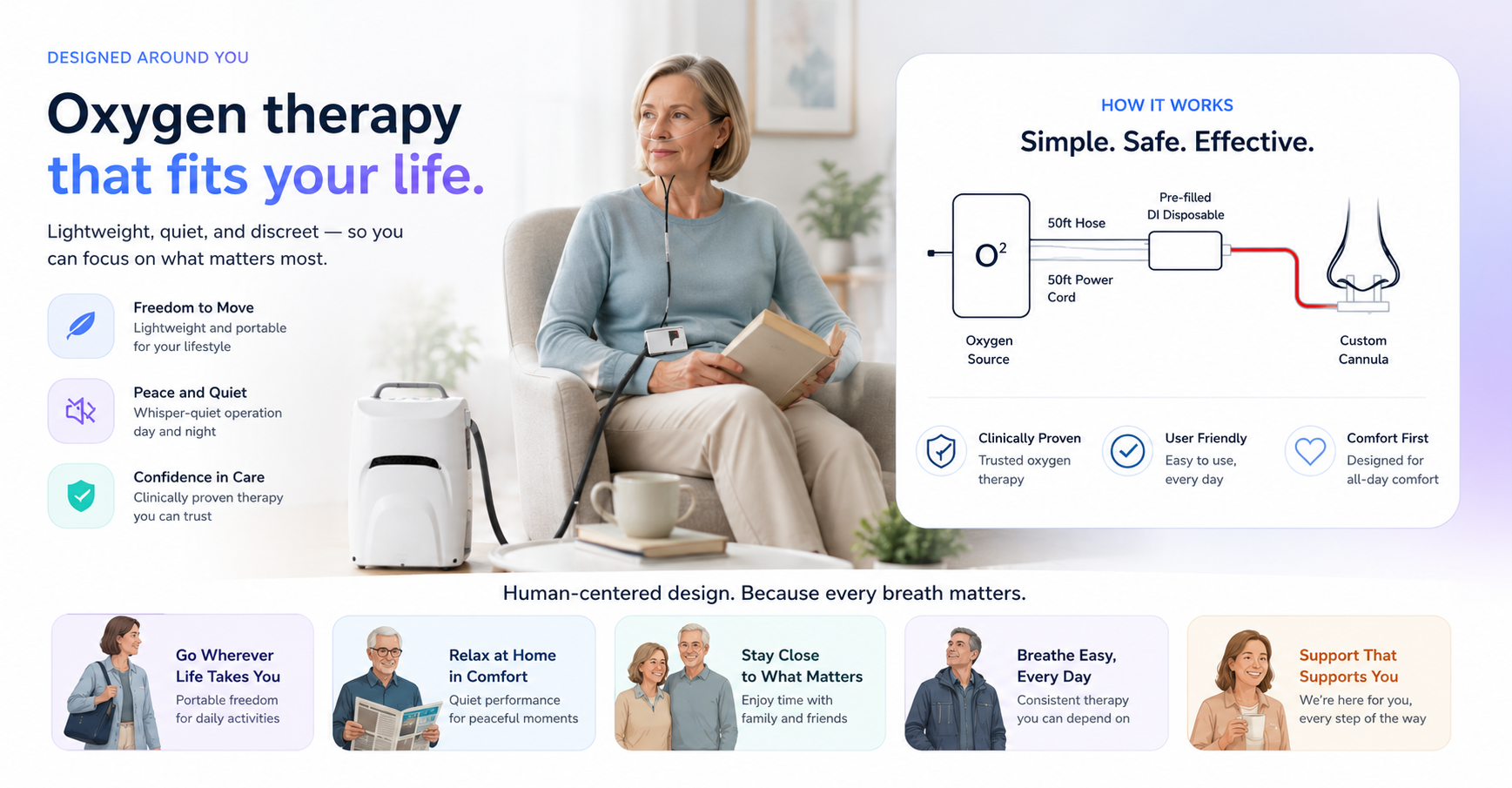
Human factors engineering (HFE)—also known as usability engineering—is the discipline of designing medical devices that are safe, effective, and intuitive for real users in real-world environments.
It combines principles from:
Cognitive psychology
Ergonomics
Behavioral science
Systems engineering
Definition:
Human factors engineering for medical devices is the process of designing and evaluating devices to ensure users can perform critical tasks safely and effectively, minimizing use-related risks, in high pressure enviroments.
Why the FDA Prioritizes Human Factors Engineering
The FDA has consistently found that a large percentage of device-related adverse events are caused not by mechanical failure—but by use-related errors.
These errors often stem from:
Confusing interfaces
Poor instructions
Complex workflows
Misalignment with real-world environments
FDA Guidance
The FDA’s guidance document:
“Applying Human Factors and Usability Engineering to Medical Devices”
Establishes clear expectations for integrating human factors into medical device development.
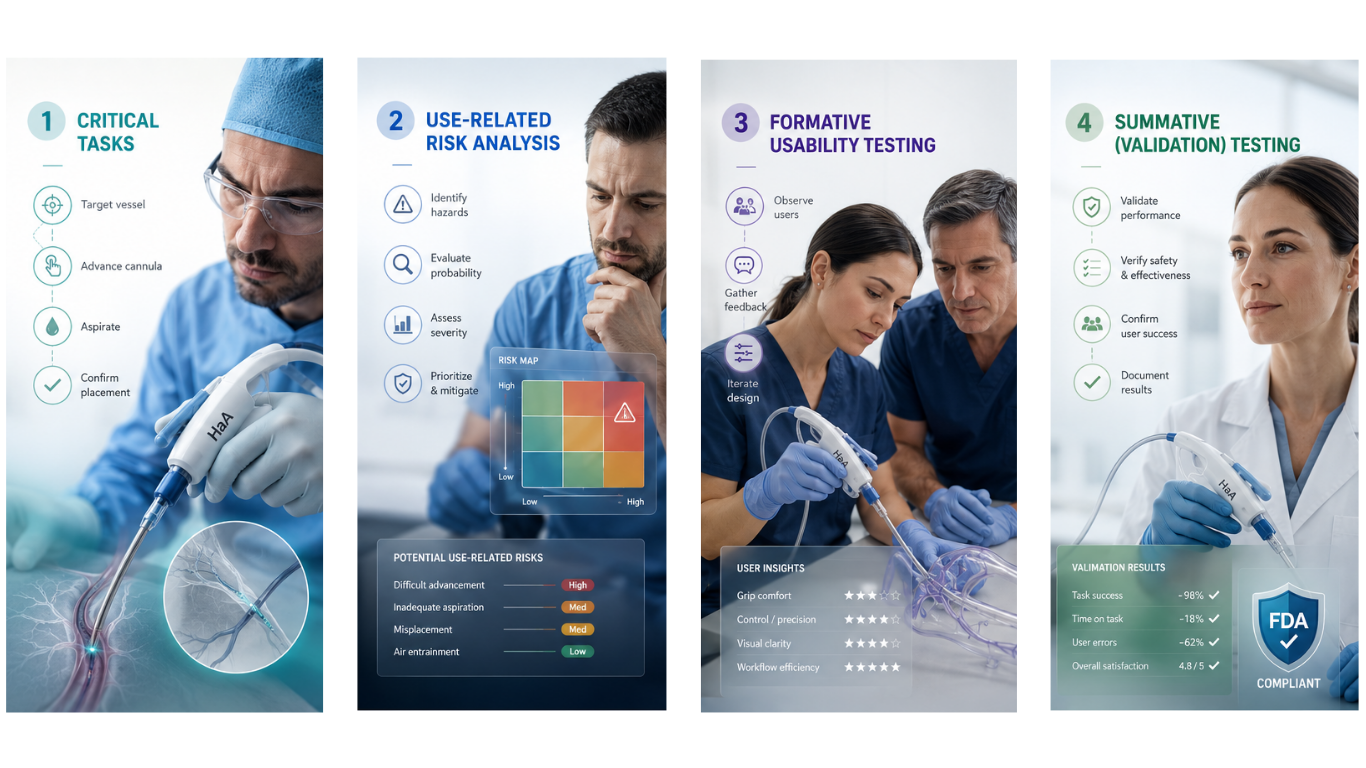
FDA Requirements Typically Include:
Identification of critical tasks
Analysis of use-related risks
Formative usability testing
Summative (validation) testing
Devices Under Increased Scrutiny:
Human factors is especially critical for:
Home-use devices
Combination products (drug + device)
Devices with digital interfaces
High-risk or life-sustaining technologies
Strategic Insight
Human factors is no longer a “nice-to-have.” It is a regulatory requirement tied directly to FDA medical device approval outcomes.
Where Human Factors Fits in the Medical Device Development Process
One of the most common mistakes made in medical device product development is treating human factors as a final validation step.
In reality, it must be integrated across the entire medical device development process.
Phase 1: User Research and Context of Use
At the earliest stage of medical device design, teams must define:
Who the users are (clinicians, patients, caregivers)
Where the device will be used (hospital, home, emergency)
What constraints users face (stress, fatigue, training level)
Why This Matters
If you misunderstand your user:
👉 Every downstream design decision becomes flawed
Phase 2: Use-Related Risk Analysis
Human factors feeds directly into risk management under ISO 14971.
Teams must identify:
Potential use errors
Hazardous situations
Severity of outcomes
Example
If a device requires a user to deliver medication:
That interaction becomes a critical task
Any failure must be mitigated through design—not training alone
Phase 3: Design and UI/UX Development
This is where medical device UI UX design becomes essential.
Design decisions should aim to:
Simplify workflows
Reduce cognitive load
Ensure intuitive design that drives correct usage
Key Principle
👉 The safest design is one that makes incorrect use difficult or impossible
Phase 4: Prototyping and Formative Testing
During medical device engineering, teams conduct iterative testing to refine usability.
This includes:
Observing real users
Identifying friction points
Adjusting interface and workflow
Why Iteration Matters
Catching usability issues early:
Reduces redesign costs
Prevents late-stage failures
Phase 5: Verification and Validation
Human factors becomes formalized during:
Verification and validation medical devices processes
Summative usability testing
This stage demonstrates that:
Users can safely complete critical tasks
Risks have been effectively mitigated
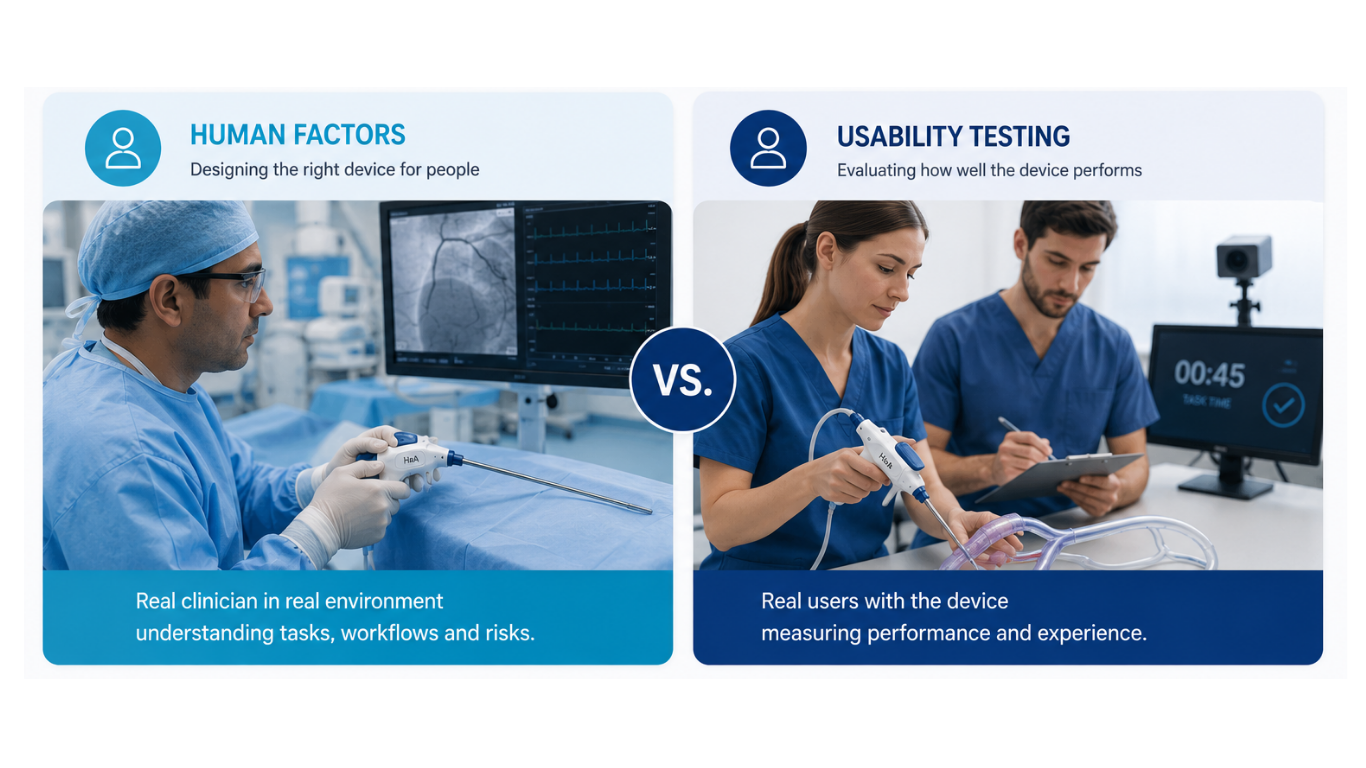
Human Factors vs Usability Testing: A Critical Distinction
This is one of the most misunderstood areas in medical device development.
Human Factors Engineering:
A continuous, strategic discipline
Integrated into design and engineering
Drives product decisions
Usability Testing:
A method used within HFE
Evaluates user interaction
Why This Matters
Many companies:
Skip early HFE work
Jump straight to validation testing
Result:
👉 Failed studies and delayed FDA approval
Types of Human Factors Testing Required
To meet FDA expectations and ensure your device is safe and usable, human factors engineering medical devices relies on two main types of testing:
Formative Testing (early-stage, iterative)
Summative Testing (final validation)
Understanding the difference between these is critical—especially if you want to avoid costly delays during FDA medical device approval.
Formative Testing (Development Phase)
Formative testing happens during the early and middle stages of medical device development. Think of it as a way to “test and improve” your design before it’s finalized.
Formative testing is where you observe real users interacting with your device and use that feedback to improve the design.
Purpose of Formative Testing
The goal is not to “pass” or “fail”—it’s to learn.
Formative testing helps teams:
Identify usability issues early
Understand how users naturally interact with the device
Improve workflows and instructions
Reduce the risk of user error
What It Looks Like in Practice
During formative testing, you might:
Ask a nurse to use a prototype device
Observe where they hesitate or make mistakes
Ask follow-up questions like:
“What were you expecting to happen here?”
“What was confusing about this step?”
You then use those insights to:
👉 Refine the design before moving forward
Key Characteristics
Iterative: Done multiple times as the design evolves
Flexible: Can be informal and adjusted as needed
Low-risk: Issues found here are much easier (and cheaper) to fix
Early and ongoing: Starts in concept and continues through prototyping
Why It Matters
Skipping formative testing often leads to:
Poor usability
Failed validation later
Expensive redesigns
👉 In short: Formative testing prevents problems before they become expensive.
Summative Testing (Validation Phase)
Summative testing happens at the end of development and is a formal requirement for FDA medical device approval.
This is where you prove that your device is safe and effective for real users.
Summative testing is where you demonstrate—under realistic conditions—that users can successfully and safely use your device without errors that could cause harm.
Purpose of Summative Testing
The goal is to validate, not explore.
Summative testing is used to:
Confirm that critical tasks can be performed correctly
Demonstrate that risks have been mitigated
Provide evidence for FDA submission
What It Looks Like in Practice
In a summative (validation) study, you might:
Recruit representative users (e.g., clinicians, patients)
Place them in a simulated real-world environment
Ask them to complete key tasks without assistance
Examples of tasks:
Administering a dose
Setting up a device
Responding to an alert
You measure:
Success rates
Errors
Time to complete tasks
Key Requirements
To meet FDA expectations, summative testing must include:
Representative users
(Actual intended users—not internal team members)Simulated environments
(Hospital room, home setting, etc.)Realistic scenarios
(Tasks that reflect real-world use)Defined success criteria
(Clear benchmarks for what counts as safe and effective use)
Why This Stage Is High Risk
Unlike formative testing, summative testing is not meant for fixing problems.
If users fail critical tasks at this stage:
The study may fail
You may need to redesign the device
Testing must be repeated
👉 This is one of the most common causes of delays in medical device product development
The Key Difference
Formative Testing = Learn and Improve (Helps you get the design right)
Summative Testing = Prove and Validate (Proves you got it right)
Why Both Are Critical for FDA Medical Device Approval
The FDA expects to see a clear progression:
You identified usability risks
You addressed them through design (formative testing)
You validated the final product (summative testing)
If this process is incomplete or poorly documented:
👉 Your FDA submission may be delayed or rejected
Strategic Insight
Many companies focus heavily on summative testing—but the real success factor is strong formative work.
Because:
👉 The better your formative testing, the smoother your validation
👉 The smoother your validation, the faster your FDA approval
Where HaA PD Adds Value
This is where many organizations struggle—especially without in-house expertise.
HaA PD helps companies:
Plan and execute formative testing early
Identify and mitigate usability risks
Design effective validation studies
Ensure alignment with FDA expectations
By integrating human factors engineering medical devices into the full medical device development process, HaA PD helps reduce risk, avoid delays, and accelerate approval timelines.
Common Human Factors Mistakes That Delay FDA Approval
1. Treating Human Factors as a Checkbox
Impact:
Weak integration with design
Poor usability outcomes
2. Waiting Too Long to Test
Impact:
Major redesigns
Restarted validation
3. Poor Definition of Critical Tasks
Impact:
Incomplete validation
FDA rejection
4. Over-Reliance on Training
FDA expectation:
👉 Devices should be safe even with minimal training
5. Weak Documentation
The FDA expects:
Traceability between risks and testing
Clear rationale for design decisions
The Growing Importance of UI/UX in Medical Devices
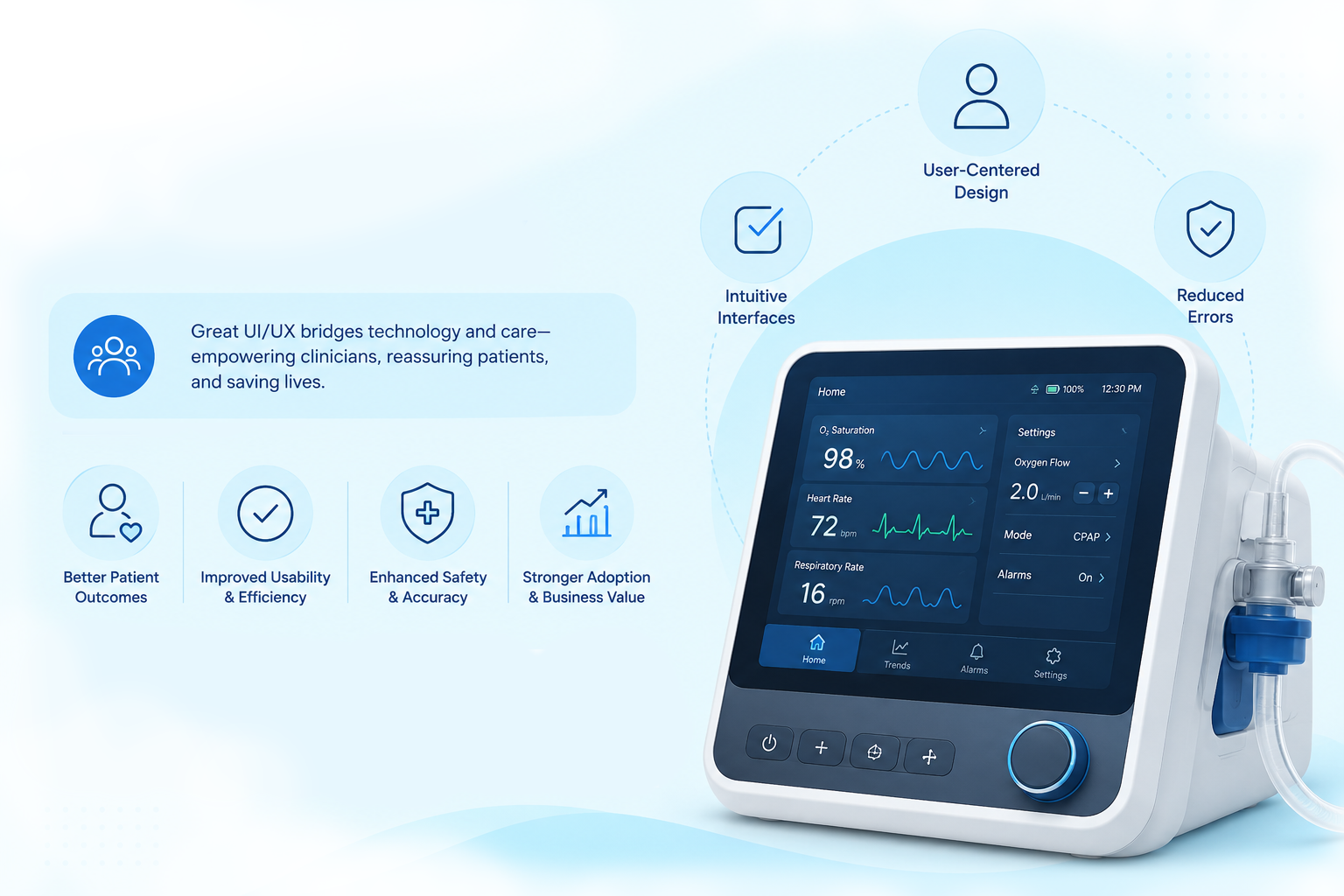
As devices become more software-driven, medical device UI UX design is now central to safety.
Poor UI/UX Leads To:
Use errors
Misinterpretation
Increased cognitive burden
Decreased safety for patients
Strong UI/UX Enables:
Faster adoption
Reduced training
Improved outcomes
Increased patient safety
Real-World Example: The Cost of Poor Human Factors
A company developing a home-use device delayed usability testing until final validation.
During testing:
Users misunderstood instructions
Critical tasks failed at unacceptable rates
Outcome:
Failed validation
Interface redesign required
6–9 month delay
How Human Factors Impacts Time, Cost, and Risk
Integrating human factors engineering medical devices early delivers measurable benefits:
Reduced Risk:
Fewer use-related errors
Stronger safety profile
Lower Costs:
Less rework
Fewer failed studies
Faster Approval:
Better alignment with FDA expectations
Regulatory Alignment: Design Controls and Human Factors
Human factors must align with:
Design controls medical devices (21 CFR 820)
Risk management (ISO 14971)
FDA compliance medical devices
FDA Expectation
There must be clear linkage between:
Risks
Design decisions
Validation testing
Why Companies Struggle with Human Factors
Common challenges include:
Lack of internal expertise
Siloed teams
Misalignment between design and regulatory strategy
How HaA PD Strengthens Human Factors Outcomes:
As a full-service medical device development company, HaA PD integrates human factors across every stage of development.
HaA PD Capabilities Include:
Human factors engineering strategy
Medical device usability testing
UI/UX design for medical devices
Risk analysis and mitigation
FDA consulting medical devices
Verification and validation support
The HaA PD Advantage: Integrated Development
HaA PD aligns:
Medical device design
Engineering
Human factors
Regulatory strategy
Result:
Reduced development risk
Faster FDA approval timelines
Stronger product outcomes
Avoidance of costly redesigns and delays
Key Takeaways
Human factors engineering is essential for FDA medical device approval
It must be integrated early in medical device development
Usability failures are a leading cause of delays
UI/UX design plays a critical role in safety and adoption
An experienced partner significantly reduces risk
Ready to Reduce Risk and Accelerate FDA Approval?
If you’re developing a medical device, integrating human factors early can dramatically improve your success rate.
HaA PD helps companies:
Design safer, more intuitive devices
Conduct effective usability testing
Align with FDA expectations